
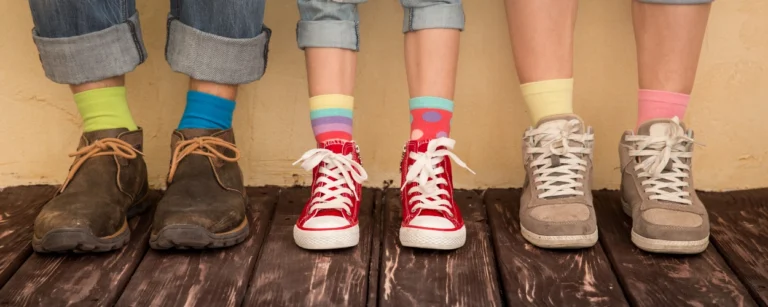
You notice it at the beach, or when your child kicks off their shoes after school. The whole sole of the foot seems to sit flat on the ground with no arch at all. Then you start watching how they walk, and everything looks slightly off.
This is one of the most common reasons parents book in with us, and the reassuring news is that flat feet in young children are usually a normal stage of development. But not always, and knowing which is which is the part that matters.
Why most children have flat feet
Babies are born without a visible arch. What looks like a flat foot in a toddler is largely a fat pad sitting under the arch, combined with ligaments that are naturally more flexible than an adult’s.
The arch typically develops between the ages of three and six as the foot muscles strengthen, the fat pad reduces and the bones mature. Some children develop an arch closer to eight or nine, and a proportion of perfectly healthy adults never develop a pronounced arch at all.
So a flat-looking foot in a three year old is not by itself a problem. What matters is whether the foot is flexible, whether it is causing symptoms, and whether the child is meeting their movement milestones comfortably.
Flexible versus rigid flat feet
This is the single most useful distinction for parents to understand.
Flexible flat feet are the common type. The arch disappears when your child stands, but reappears when they sit down, go up onto their toes, or when you lift the big toe. The joints move freely and the foot is not painful. Most flexible flat feet need nothing more than monitoring and sensible footwear.
Rigid flat feet stay flat regardless of position. No arch appears when the child is sitting or on tiptoes, and the foot often feels stiff to move. Rigid flat feet warrant proper assessment, because they can be associated with underlying structural issues that respond much better to early intervention than late intervention.
You can do the tiptoe test at home in about ten seconds. Ask your child to stand up and rise onto their toes. If an arch appears, the foot is flexible.
Signs that are worth getting checked
Book an assessment if you notice any of the following:
- Your child complains of foot, ankle, knee or leg pain, particularly after activity
- They ask to be carried more than other children their age, or tire quickly on walks
- They avoid running games or sport they used to enjoy
- One foot looks noticeably different from the other
- Shoes wear out unevenly, or very rapidly on one edge
- They trip or fall more often than their peers
- Persistent night-time leg pain that wakes them
- The foot stays flat on tiptoes
- They walk on their toes most of the time
Growing pains are often blamed for symptoms that are actually mechanical. A child who is genuinely sore after a Saturday of sport is telling you something about how their foot and leg are loading, and that is assessable. Our post on heel pain in children covers one of the more common presentations we see in the eight to fourteen age bracket.
Signs you need infected ingrown toenail treatment
Book an appointment promptly if you notice any of the following:
- Yellow or green discharge, or any pus
- Redness spreading beyond the immediate nail fold, or up the toe
- Throbbing pain, or pain that wakes you at night
- A lump of shiny red tissue growing over the nail edge, known as hypergranulation tissue
- The toe feels warm to touch
- Fever, or feeling generally unwell
- No improvement after five days of proper home care
Infected ingrown toenail treatment is not something to delay. An infection sitting against bone in a small toe can escalate quickly, and antibiotics alone rarely solve it because the nail spike causing the problem is still sitting in the tissue. The nail edge has to be removed for the infection to clear properly.
Book Your Podiatry Assessment Today
What happens at a paediatric podiatry appointment
Parents often worry that an appointment will be distressing for a young child. In practice it is mostly conversation, observation and play.
Justin Mansour, our principal podiatrist and the founder of the clinic, has a particular interest in paediatric podiatry and has spent years assessing developing feet. His background in medical science, with majors in neuroscience and pharmacology before completing his Masters of Podiatric Medicine, means the assessment goes well beyond a quick look at the arch.
A typical appointment includes:
- A discussion of your child’s history, milestones, activity levels and any symptoms you have noticed
- Looking at the feet standing, sitting and on tiptoes to determine flexibility
- Assessing joint range of motion, muscle strength and calf flexibility, which is frequently the hidden driver
- Watching your child walk and run, so we can see the whole leg working rather than just the foot
- Checking the footwear they have been wearing, which tells us a surprising amount
- A clear explanation of what we found and whether anything needs doing
Often the outcome is genuine reassurance and a review in twelve months. That is a good result, and it is worth having rather than spending three years wondering.
What treatment looks like when it is needed
Where intervention is warranted, it is rarely dramatic.
Footwear changes come first. A supportive shoe with a firm heel counter, a fastening that actually holds the foot in place and appropriate flexibility at the ball of the foot does a great deal of work. Our guide to choosing the right school shoe is a useful starting point, given how many hours a week those shoes are worn.
Strengthening and stretching targeted at the calf, foot and hip. Children respond very well to exercise-based programs, and we set them up as games rather than clinical drills so they actually get done.
Orthotic therapy where the foot needs mechanical support to load correctly while it develops. Orthoses are not a lifelong commitment for most children, and they are not a substitute for building strength.
Activity modification through a growth spurt, if pain is being driven by load rather than structure.
There are also things you can try at home first, which we have covered in our post on at-home care for children’s flat feet.
When to act
The general rule: flexible, painless flat feet in a child under six are almost always fine and need nothing but occasional monitoring. Flat feet that hurt, that are rigid, that are affecting your child’s activity, or that persist well past eight, deserve a proper assessment.
Early assessment is low cost and low risk. Waiting until a teenager has chronic heel pain and has given up sport is a considerably harder problem to solve.
If something about your child’s feet or the way they move has been sitting in the back of your mind, get it checked and either act on it or stop worrying about it.
Book an appointment online or call our Petersham clinic on (02) 9188 8432. You can read more about our paediatric podiatry services and how we work with children.