
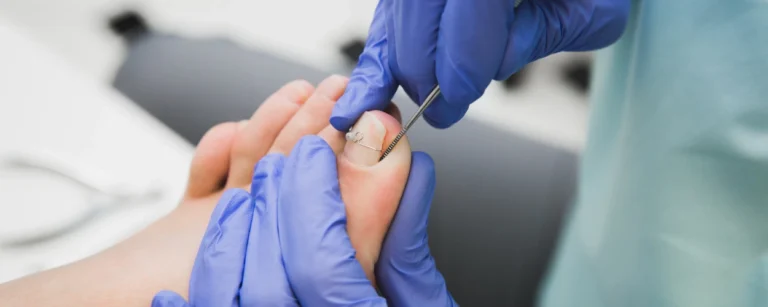
An ingrown toenail starts small. A bit of tenderness on the side of the big toe, maybe some redness you only notice in the shower. Then a week later you are wincing every time your shoe touches it, and sleeping with your foot outside the blanket.
Most ingrown toenails do respond to good home care in the early stages. The problem is that the wrong home care makes things considerably worse, and a lot of the advice floating around online falls into that second category. Here is what actually helps, what to avoid, and the point at which home treatment for an ingrown toenail stops being enough.
What causes an ingrown toenail
An ingrown toenail happens when the edge of the nail plate pierces the skin beside it, usually on the big toe. The body treats that nail edge as a foreign object, so it responds with inflammation, swelling and pain.
Common causes we see at the clinic:
- Cutting the nails too short or curving them down at the corners, which leaves a sharp spike behind
- Picking or tearing nails instead of cutting them
- Tight, narrow or pointed shoes that compress the toes
- Sports with repeated toe impact, including running, football and dancing
- Naturally curved or involuted nail shape, which tends to run in families
- Trauma, such as dropping something on the toe or a heavy foot landing
- Sweaty feet, which soften the skin and make it easier for the nail to penetrate
Understanding the cause matters, because a nail that keeps growing back into the same spot is telling you the shape of the nail or the way it is being cut needs addressing, not just the current flare-up. Our guide on what you can do to prevent ingrown toenails covers this in more depth.
Safe home treatment for an ingrown toenail
If the toe is sore and slightly red but there is no pus, no spreading redness and no throbbing, you can reasonably try home care for a few days.
- Soak the foot in warm salty water. Ten to fifteen minutes, once or twice a day. Use warm water with a tablespoon of salt. This softens the skin, calms the inflammation and helps keep the area clean.
- Dry the toe properly afterwards. Get in between the toes. Moist skin is softer skin, and softer skin is easier for the nail to cut into.
- Apply an antiseptic. A simple antiseptic solution or cream over the affected edge, then a light dressing if the toe is rubbing on your shoe.
- Change your footwear for now. Open-toed shoes, sandals or your widest pair. Anything that presses on the side of the nail is going to keep the irritation going no matter how well you soak.
- Cut the nail straight across, not down the sides. Leave the corner of the nail visible past the skin. Do not round the edges off.
Give it three to five days. If it is settling, keep going. If it is not, or if it is getting worse, stop and get it looked at.
What not to do
This is the part that matters most, because these are the habits that turn a manageable ingrown nail into an infected one.
Do not perform bathroom surgery. Digging at the nail edge with clippers, tweezers or a needle almost always leaves a fragment of nail behind and creates an open wound at the same time. That combination is exactly how infections start.
Do not cut a V into the middle of the nail. It is a persistent myth that this pulls the sides in. It does nothing to the nail edges, which is where the actual problem is.
Do not push cotton wool or dental floss under the nail. It traps moisture and bacteria against broken skin.
Do not ignore it and hope it resolves. Ingrown nails rarely fix themselves once the skin has been broken.
Signs you need infected ingrown toenail treatment
Book an appointment promptly if you notice any of the following:
- Yellow or green discharge, or any pus
- Redness spreading beyond the immediate nail fold, or up the toe
- Throbbing pain, or pain that wakes you at night
- A lump of shiny red tissue growing over the nail edge, known as hypergranulation tissue
- The toe feels warm to touch
- Fever, or feeling generally unwell
- No improvement after five days of proper home care
Infected ingrown toenail treatment is not something to delay. An infection sitting against bone in a small toe can escalate quickly, and antibiotics alone rarely solve it because the nail spike causing the problem is still sitting in the tissue. The nail edge has to be removed for the infection to clear properly.
Book Your Podiatry Assessment Today
What a podiatrist actually does
Most people expect the appointment to be worse than it is.
For a straightforward ingrown nail, the podiatrist removes the offending spike of nail and clears the nail sulcus. It takes a matter of minutes, and the relief is usually immediate. Many patients walk out saying they wish they had come in a fortnight earlier. Our post on what to expect at your ingrown toenail appointment walks through the visit step by step.
For nails that keep coming back, or ones that are badly infected, the long-term fix is a partial nail avulsion. Local anaesthetic is used to numb the toe, the offending edge of the nail is removed, and a chemical is applied to the nail matrix so that section does not grow back. The nail looks normal afterwards, just slightly narrower. You can read more about what is involved in nail surgery if it is something you are considering.
The procedure has a high success rate and takes most patients out of a cycle they have been stuck in for years.
Do not sit on it
Home care works for early, uncomplicated ingrown toenails. It does not work once the skin is broken, once there is infection, or once the same nail has been ingrowing repeatedly.
If you have been soaking your toe for a week with no improvement, or you are seeing any of the infection signs above, the sensible move is to get it treated properly rather than manage around it.
Book an appointment online or call the Petersham clinic on (02) 9188 8432. You can also learn more about our ingrown toenail treatment and what it involves.